

Use our 12ct gold price calculator to check today's indicative value per gram in GBP. Enter the eligible weight of your solid 12 carat gold, then check the selected purity. The 12ct gold price gives you a starting point before an assessment.
12ct gold · indicative GBP per gram
Market value, not a buying offer. How your offer is determined.
12ct gold price calculator
Enter the alloy weight in grams. Check the selected purity.
12ct gold price estimates by weight
These examples use the same indicative 12ct rate shown above: £47.02 per gram. They estimate metal value, not a guaranteed buying offer. Exclude stones and non-gold parts from the weight.
| 12ct gold weight | Calculation | Indicative metal value |
|---|---|---|
| 1g | 1 × £47.02 | £47.02 |
| 2g | 2 × £47.02 | £94.04 |
| 5g | 5 × £47.02 | £235.10 |
| 10g | 10 × £47.02 | £470.20 |
| 20g | 20 × £47.02 | £940.40 |
Estimated metal value = eligible 12ct alloy weight × the displayed price per gram. For example, a 5g piece made entirely from 12ct alloy uses five times the rate. The table covers common weights, while the calculator accepts your own measurement.
However, the 12ct gold price per gram estimates metal value rather than a guaranteed payment. Stones, steel springs and other non-gold parts can increase an item's weight. Therefore, establish what your measurement includes before comparing it with a buying offer.
How to use the 12ct gold price calculator
First, check any readable marks and identify the item you want to value. This page starts with 12ct selected. Use that setting only when the item's markings, records or an assessment support a 12 carat purity.
- Weigh in grams. Keep boxes, bags and loose packaging off the scales.
- Enter the eligible alloy weight. The tool accepts decimal weights above zero and up to 1,000g.
- Check the purity and calculate. Your result shows an indicative metal value in pounds sterling.
- Record your estimate. Note the weight, purity and price-check time for a later comparison.
For mixed items, calculate each known purity separately. For instance, a 12ct pendant and a 9ct chain need different rates. If you cannot establish their separate weights, ask about assessment before relying on the combined result.
What 12ct, 12k and 500 fineness mean
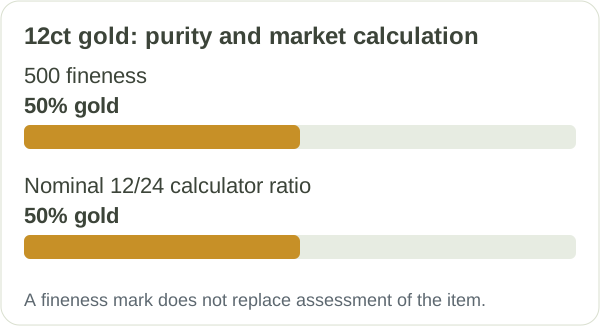
12ct and 12k describe twelve parts gold out of 24: 50% pure gold. In fineness terms, that equals 500 parts gold per thousand. Other metals form the remaining half of the alloy.
For example, 10g of solid 12ct alloy contains 5g of pure gold. Nevertheless, enter 10g in the 12ct gold price calculator. The 12ct gold price already includes the 50% purity adjustment, so entering 5g would apply that adjustment twice.
A numerical mark alone cannot confirm an item's composition. Read it alongside the other marks and consider any signs of repair. Also, colour does not establish purity: different alloys and surface finishes can look similar.
Older jewellery and historic British hallmarks
The UK introduced the 12 carat hallmarking standard in 1854 and discontinued it in 1932. The Birmingham Assay Office's historical timeline records these changes. As a result, older British jewellery may carry a 12ct mark even though it is not a current UK hallmarking standard.
Look at the complete group of marks rather than interpreting one number in isolation. Our hallmark guide explains the different roles of purity and assay marks. However, an incomplete or worn mark may need specialist interpretation.
The 12ct gold price gives a metal reference for a confirmed 12ct item. It does not establish the age, maker or collector value of an antique. Therefore, consider a specialist valuation before selling a piece that may have value beyond its gold content.
Solid gold versus gold-filled or plated items
Read any letters next to a carat mark. For example, 12K GF describes a gold-filled item with a 12 carat gold-alloy layer, rather than 12ct alloy throughout. A base-metal core contributes to the total weight.
Consequently, you should not multiply that item's full weight by the 12ct gold price per gram. The same caution applies to gold-plated or rolled-gold pieces. The calculator needs the eligible gold-alloy weight, which the total weight alone cannot establish.
If a mark includes extra letters or a fraction, record the whole inscription. Then contact our team before treating the piece as solid gold. Avoid scraping the surface or dismantling the item to investigate its construction.
Stones, clasps and replacement components
A home scale measures everything on its platform. For example, a 6g stone-set ring may contain only 5g of eligible gold alloy after assessment. In that example, multiply 5g by the 12ct gold price per gram for its indicative metal value.
Likewise, a replacement clasp or added charm may have a different purity from the original chain. Keep notes for each identifiable component. If you cannot separate their weights reliably, keep the item intact and describe it when you enquire.
Also, use the precision your scales actually provide. Adding extra decimal places does not improve an uncertain reading. Photograph the item and its marks for your records, then keep those details beside your estimate.
Reviewing your offer before selling
We assess your items' weight and gold content before making a confirmed offer. Your payment can differ from the 12ct gold price estimate because the assessed weight, purity or buying rate differs. Market movements can also affect the comparison.
Before accepting, review the eligible weight, rate and final amount payable. There are no deductions from your agreed offer. Ask us to explain any difference before deciding whether to sell.
Our testing information explains the assessment process. Alternatively, read our scrap gold guide if you have broken jewellery or single earrings. An item can still contain gold even when it is no longer wearable.
How we calculate the 12ct gold price
We convert the international gold price per troy ounce into GBP per gram, then multiply by 12/24. Next, we round the rate to two decimal places. The price panel, table and 12 carat gold price calculator use the same market snapshot.
Our sources are Gold API for gold and ExchangeRate-API for USD/GBP. We check rates at intervals of up to ten minutes. However, the check time can differ from the underlying market and exchange-rate timestamps.
Finally, reload the page before comparing a later estimate. For other purities, use our 9ct, 14ct, 18ct, 22ct or 24ct guide. Keep the weight and carat unchanged when checking for a movement in the rate.
Questions about this gold price
These prices are indicative estimates, not guaranteed purchase offers. Check the update time above. Your final offer follows assessment of eligible weight and purity.
What is the current 12ct gold price in the UK?
The indicative metal value of 12ct gold per gram in GBP is £47.02. This is a market-based estimate, not a guaranteed buying offer.
How is the 12ct gold price calculated?
The 12ct gold price is calculated from the international gold spot price, the GBP exchange rate, and the nominal 12/24 carat ratio. The displayed per-gram rate already accounts for purity.
How pure is 12ct gold?
12ct or 12k gold contains 50% pure gold, equivalent to 500 parts per thousand. UK assay offices discontinued the 12ct hallmarking standard in 1932. A mark alone does not establish the gold content of an item.