

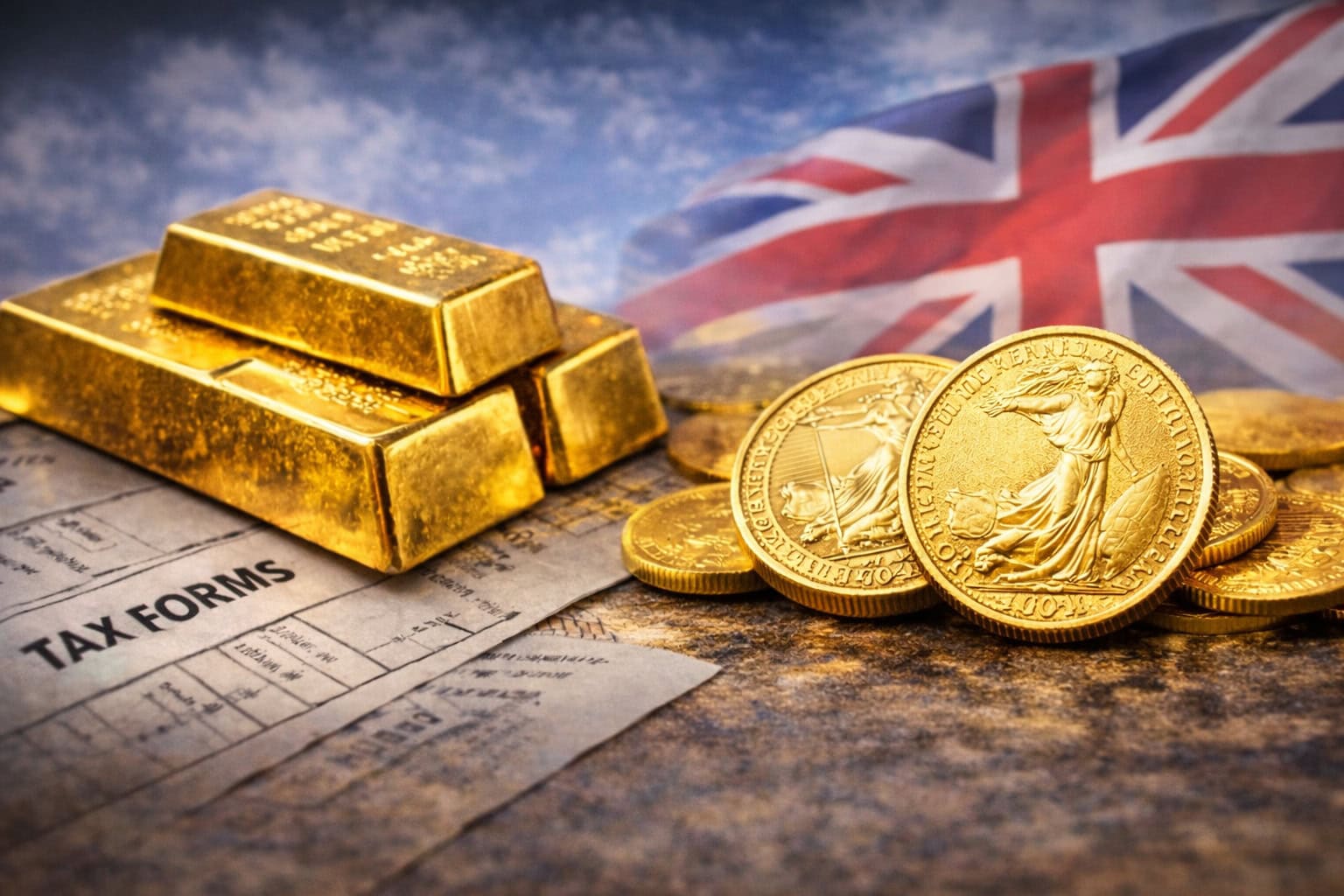
If you’re thinking about selling gold jewellery, coins, or bars, one of the first questions is usually: “Do I have to pay tax on this?”
The answer depends on what kind of gold you’re selling, whether you’re making a profit, and in some cases whether the gold is treated as UK currency or “investment gold.”
This guide explains, in plain English, how Capital Gains Tax (CGT) and VAT can apply when selling gold in the UK — and when they usually don’t.
Want to check value first?
Start here: sell gold per gram (live prices).
Note: This article is general information, not personal tax advice. If your situation is complex (high values, frequent trading, business activity), consider speaking to a qualified accountant.
When can selling gold be taxable?
In the UK, selling gold may be taxable if it counts as disposing of an asset and you make a chargeable gain (profit). The most common tax that comes up is Capital Gains Tax (CGT).
You typically start thinking about CGT when:
- You bought gold as an investment (coins or bars) and it increased in value
- You sell multiple items and the total gains are meaningful
- You regularly buy and sell for profit (different rules can apply)
If you’re selling jewellery or scrap and want a simple overview of the process, see: how does gold selling work?
The CGT allowance (2025–2026 tax year)
CGT is generally only due on gains above your annual tax-free allowance (also called the “annual exempt amount”).
For the 2025–2026 tax year, HMRC’s published guidance uses an annual exempt amount of
£3,000. You can check the current allowance here: HMRC CGT rates & allowances
If your total chargeable gains across all assets in that tax year are below the allowance, there’s usually no CGT to pay.
The big exception: CGT-free UK legal tender gold coins
Some gold coins are treated as sterling currency, and sterling currency is exempt from CGT.
HMRC specifically notes that:
- Sovereigns minted from 1837 onwards, and
- Britannia gold coins
…are treated as currency and are exempt from CGT. See HMRC guidance here: HMRC Capital Gains Manual (CG78305)
Need a valuation on coins? See: sell gold coins.
Important: Not all gold coins are CGT-free. HMRC indicates coins are treated as “currency” for these purposes only when they are legal tender at the time of acquisition or disposal. Many non-UK bullion coins can still be chargeable assets.
What about jewellery and scrap gold?
Most people selling jewellery aren’t thinking about “profit”
If you’re selling jewellery you bought years ago, the sale price is often less than the original retail price.
In those cases, there’s usually no gain, so there’s typically no CGT.
To estimate today’s value quickly, use: gold price per gram.
When jewellery could create a taxable gain
If jewellery was bought cheaply (or inherited with a low acquisition value) and later sold for much more, you may have a gain.
HMRC also has rules around “chattels” (personal possessions), which can affect CGT calculations in some cases (especially for higher values).
If you’re selling high-value pieces or collections, it’s worth checking your position.
Practical rule of thumb:
- One-off jewellery sales: often not taxable in practice
- High-value items / big profit / repeated sales: consider professional advice
VAT: is gold subject to VAT in the UK?
VAT depends on whether the gold counts as “investment gold.”
HMRC defines investment gold coins using criteria such as purity, legal tender status, and typical market premium.
You can read the official guidance here: HMRC VAT Notice 701/21A (Investment gold coins)
In plain terms:
- Many well-known bullion coins meet the investment criteria and are treated differently to standard goods
- If you’re unsure, check whether a coin qualifies under HMRC’s criteria
Do I need to declare selling gold to HMRC?
You may need to declare a disposal if:
- You’ve made total gains above the CGT allowance for the tax year
- You’re selling chargeable assets with meaningful profit
- Your activity looks like trading (frequent buying and selling for profit)
If you’re selling CGT-exempt UK legal tender coins like Sovereigns (post-1837) and Britannias, the CGT position is generally different
because they’re treated as sterling currency (per HMRC guidance linked above).
A simple record-keeping checklist
- Any purchase receipts (if you have them)
- Notes of approximate purchase date and price
- Photos/descriptions of the items
- The sale confirmation / receipt
Sell gold safely and simply with Moonstone Gold
Whatever you’re selling – jewellery, scrap, or coins — the most important thing is that the process is clear, fair, and secure.
At Moonstone Gold, we aim to make it straightforward:
- Clear valuation process
- Fast turnaround
- A safe way to sell without the hassle
Ready to sell?
Use: sell gold for cash.
If you want to understand the step-by-step process first, read: how does gold selling work?
Is selling inherited gold taxable?
Inheritance itself is separate from CGT. Tax depends on what happens when you sell and whether there’s a gain.
If you’ve inherited valuable items, it’s worth getting professional advice.
Are Sovereigns and Britannias always CGT-free?
HMRC states Sovereigns minted from 1837 onwards and Britannias are treated as sterling currency and exempt from CGT.
See: HMRC CG78305
Do I pay VAT when I sell gold?
VAT treatment depends on whether the product is classed as “investment gold” and the nature of the transaction. HMRC defines the criteria here: VAT Notice 701/21A