

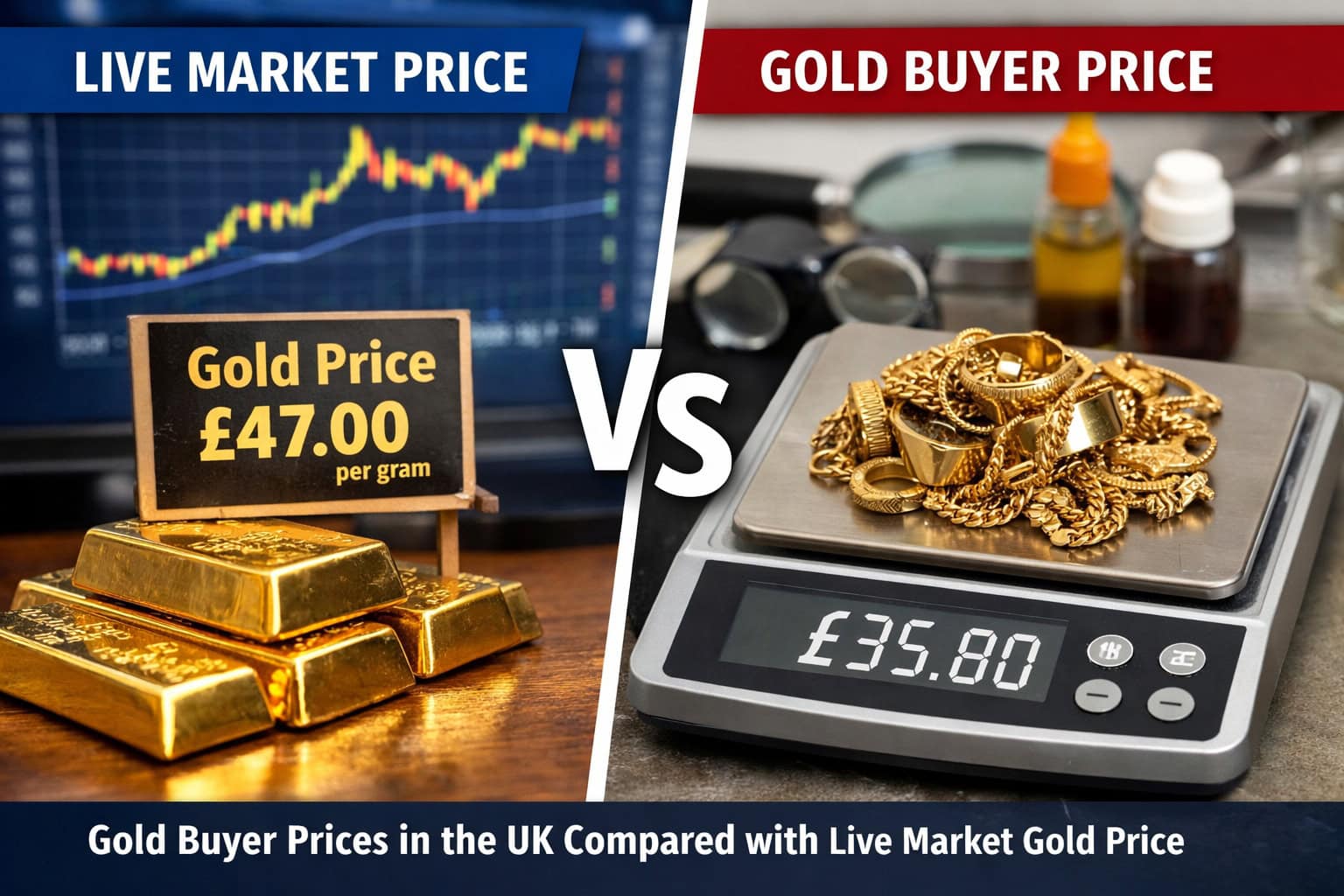
Gold buyer prices are often lower than the headline gold market rate. Therefore, sellers sometimes wonder why gold buyers do not pay the full price shown online. The difference comes from purity, recoverable weight, testing, refining costs and market risk.
The quoted market rate is a reference price for fine gold. However, jewellery and scrap items may contain other metals, stones or non-metal parts. As a result, a buyer must assess each item before making an offer.
How Gold Buyer Prices Are Calculated
Buyers begin with the relevant market rate. Next, they assess the item’s purity and eligible weight. They also consider processing costs and their commercial terms.
For official benchmark information, visit the LBMA Gold Price. You can also read market research from the World Gold Council.
Why Gold Buyers Pay Less Than the Market Rate
Most jewellery and scrap items are not pure gold. In addition, buyers must verify the material before they can resell or refine it. Therefore, an offer will usually be lower than the fine-gold benchmark.
This does not automatically mean that an offer is unfair. Instead, compare the offer with the item’s estimated recoverable gold content and the buyer’s stated terms.
Gold Purity and Its Effect on Value
Gold purity is one of the main factors behind gold buyer prices. For example, 9-carat gold contains 37.5% gold, while 18-carat gold contains 75% gold. Consequently, two items with the same total weight can have very different values.
A hallmark may provide useful purity information. The official UK hallmarking guidance explains common fineness marks. Nevertheless, a buyer may still test the item before confirming an offer.
You can use the Moonstone Gold gold value calculator for an initial estimate.
Testing and Valuation Costs
Buyers need to confirm the purity, weight and authenticity of each item. For instance, they may use inspection, acid testing or X-ray fluorescence equipment. This process requires trained staff, suitable equipment and secure handling.
Consequently, testing contributes to the buyer’s operating costs. It also helps the buyer avoid paying a pure-gold rate for an item with a lower gold content.
How Refining Affects Gold Buyer Prices
Many scrap items cannot be resold in their existing condition. Instead, buyers may send them for melting and refining. This process separates recoverable gold from other materials.
However, refining can involve transport, secure storage, treatment charges and settlement delays. Therefore, these costs may affect the final amount offered to the seller.
Business Costs and Buyer Margins
Gold buyers operate commercial businesses. As a result, they must cover staff, insurance, security, compliance, payment and premises costs. Online businesses may have different costs from high-street shops.
In addition, a buyer needs a commercial margin. This margin is another reason why gold buyers pay less than the headline market rate.
Market Risk and Price Movements
Gold prices can move after a buyer makes an offer. For this reason, the buyer may include a buffer for short-term market risk. The size of that buffer can vary between businesses.
Currency movements can also affect UK valuations. International gold prices are commonly quoted in US dollars. Therefore, changes in sterling may influence the price available to a UK buyer.
Read more about significant gold-market fluctuations.
Why Offers Differ Between Buyers
Not every buyer has the same testing process, refining arrangement or operating costs. Consequently, gold buyer prices can differ even when sellers request valuations on the same day.
Some businesses quote a percentage of the market rate. Others calculate an item-specific offer after testing. Therefore, check what the quoted figure includes before comparing two offers.
How to Compare Gold Buyer Prices
Look beyond the headline number when comparing buyers. In particular, review the following factors:
- The purity and eligible weight used in the calculation
- Any testing, refining or administration deductions
- Postage and insurance arrangements
- Payment times and methods
- The process for declining an offer and returning items
- The buyer’s contact details, terms and independent reviews
Once you understand these points, the difference between the market price and the purchase offer becomes clearer.
Steps That May Improve Your Result
Although buyers do not pay the full fine-gold rate, preparation can help you assess an offer. First, check the current benchmark price. Next, identify any visible hallmark and obtain an approximate weight.
- Check current gold-market information.
- Identify the item’s carat or fineness where possible.
- Use home scales only for a rough estimate.
- Choose a buyer with clear valuation terms.
- Compare complete offers rather than headline percentages.
- Review the returns process before sending your items.
Finally, remember that an online estimate is not a guaranteed offer. Professional testing determines the eligible gold content.
Understanding Gold Buyer Prices and Your Final Offer
In simple terms, purity, weight, costs and risk explain why gold buyers do not pay full price in the UK. The market rate provides a starting point, while the item’s recoverable value shapes the final offer.
Ultimately, transparent gold buyer prices should be supported by clear information. Ask questions if you do not understand how the buyer reached its valuation.
You can use the Moonstone Gold gold value calculator or learn how to sell gold online.