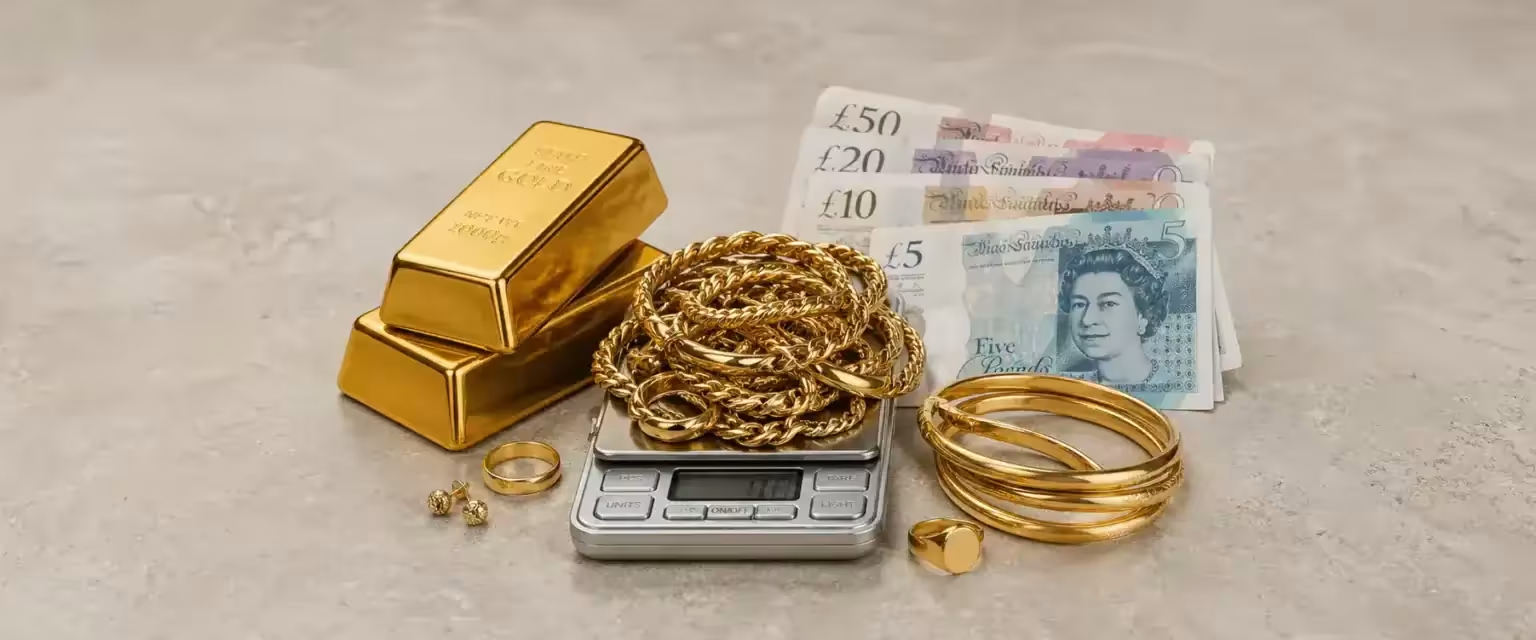


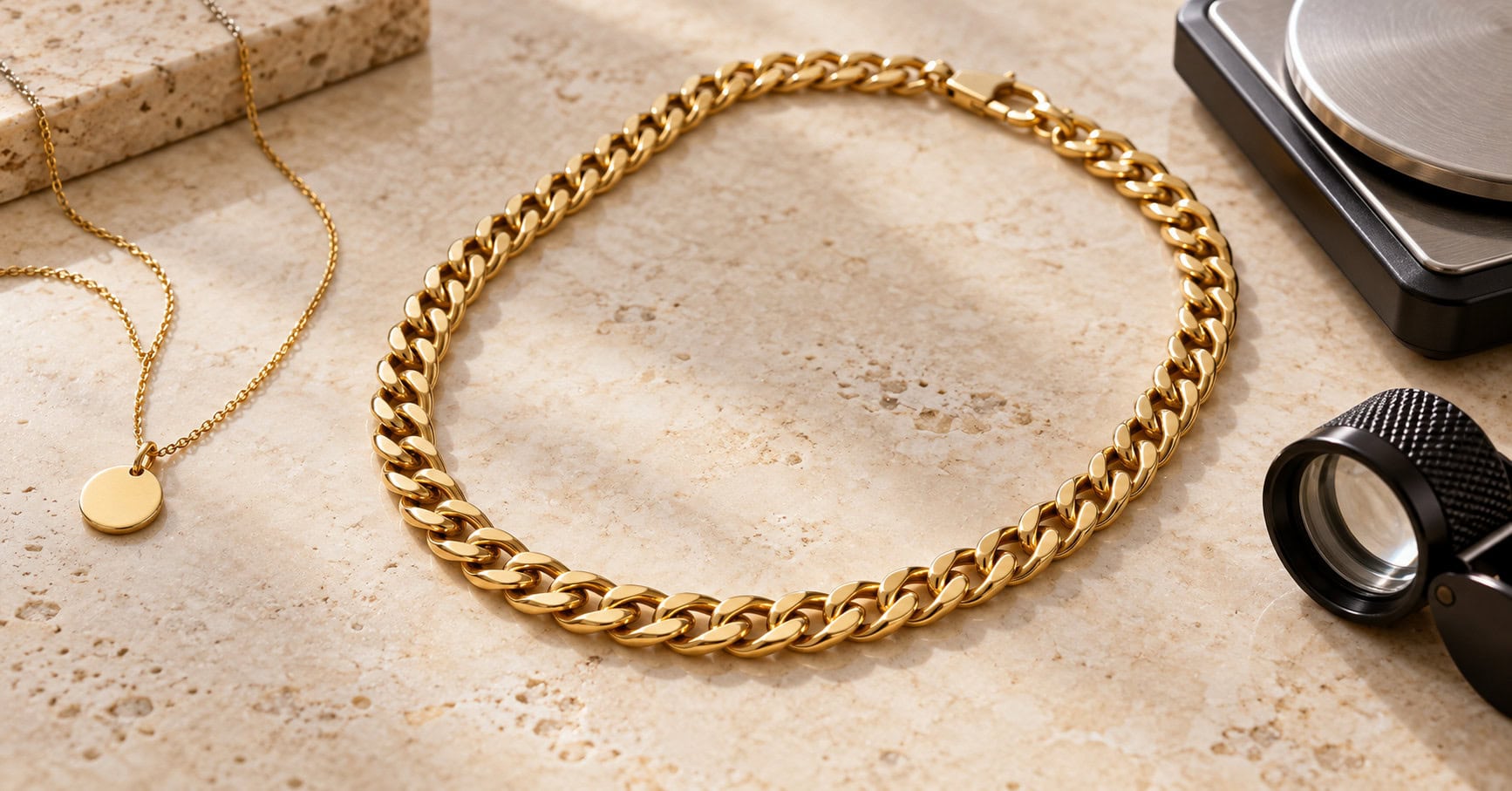
A gold necklace’s value depends mainly on its weight, gold purity and the current gold price. However, a designer necklace, antique chain or valuable pendant may be worth more as jewellery than its gold content alone.
To work out how much a gold necklace is worth, first check its carat and weigh it in grams. Then account for any stones, separate pendants or non-gold components. Together, these details help you understand the offers you receive.
If you already know your necklace’s weight and carat, use our UK gold price calculator for an initial estimate. However, the final offer will depend on assessment and the buyer’s terms.
What Type of Necklace Value Are You Looking For?
A necklace can have several different values. Therefore, before comparing figures, check what each valuation represents.
- Gold-content value: The theoretical market value of the fine gold contained in the necklace, before a buyer’s margin or processing costs.
- Scrap purchase offer: The amount a buyer offers based primarily on the necklace’s recoverable gold.
- Second-hand jewellery value: What someone may pay for the complete necklace, including its design, maker, condition and stones.
- Insurance replacement value: An estimate of the cost to replace the necklace, rather than the amount you would receive when selling it.
The original shop price may include manufacturing, retail costs and a brand premium. As a result, a gold-content valuation can be considerably lower than the original purchase price.
How to Calculate a Gold Necklace’s Value
There are two useful calculations, depending on the rate you have. First, establish whether you are using a buyer’s rate for your necklace’s carat or a fine-gold market price.
Using a Buyer’s Rate for Your Gold Carat
Estimated payment = eligible gold-alloy weight in grams × the buyer’s price per gram for that carat.
For example, if a buyer quoted £30 per gram for 9ct gold, a 10g necklace made entirely from eligible 9ct gold alloy would give an estimate of £300 before any separately stated deductions.
This £30 rate is an illustration, not a current Moonstone quote. Because the rate already applies to 9ct gold, you should not multiply the result by 37.5% again.
Using the Fine-Gold Market Price
Estimated gold-content value = gold-alloy weight in grams × gold purity × fine-gold price per gram.
For example, a 10g 9ct necklace contains approximately 3.75g of fine gold. You can then multiply that fine-gold weight by the market price per gram to estimate its gold-content value.
However, this calculation does not establish the amount a buyer will pay. Before accepting an offer, ask whether the quoted rate includes the buyer’s margin and whether any other charges apply.
Check Your Necklace’s Carat and Hallmarks
First, look for small marks near the clasp, on a tag beside it or on the pendant. If the marks are difficult to read, a magnifying glass may help.
| Gold carat | Fineness mark | Gold content |
|---|---|---|
| 9ct | 375 | 37.5% |
| 14ct | 585 | 58.5% |
| 18ct | 750 | 75% |
| 22ct | 916 | 91.6% |
These numbers describe gold content in parts per thousand. However, a number alone is not the same as a complete UK hallmark. For more detail, see the Birmingham Assay Office guide to reading hallmarks.
A missing or worn mark does not, by itself, prove that a necklace is not gold. Equally, a stamp should not replace professional testing where authenticity is uncertain.
In addition, a replacement clasp may differ from the chain. Therefore, its mark should not be treated as proof of the whole necklace’s purity.
Gold Necklace Value Examples by Weight and Carat
The following examples show how weight and purity affect gold-content value. For consistency, every calculation uses an illustrative fine-gold price of £80 per gram. This is not today’s price or a purchase offer.
Each example assumes the stated weight consists entirely of gold alloy of the stated fineness. Therefore, no stones or non-gold components are included.
| Necklace weight | 9ct gold | 14ct gold | 18ct gold | 22ct gold |
|---|---|---|---|---|
| 5g | £150 | £234 | £300 | £366.40 |
| 10g | £300 | £468 | £600 | £732.80 |
| 20g | £600 | £936 | £1,200 | £1,465.60 |
For example, the 10g 18ct calculation is 10 × 0.750 × £80 = £600. Meanwhile, the 22ct examples use the 916 fineness shown above.
To get an estimate based on current pricing, enter your necklace’s details into our gold calculator.
Does a Hollow Gold Chain Have Less Value Than a Solid Chain?
A hollow chain has spaces inside its links. As a result, it can look substantial while weighing relatively little. By comparison, a solid-link chain of similar dimensions will generally contain more metal.
However, gold-content valuation depends on actual weight and purity. If a hollow 9ct chain and a solid-link 9ct chain each contain 10g of the same gold alloy, their theoretical gold-content values are the same.
Therefore, do not estimate value from thickness or length alone. A wide hollow chain can contain less gold than a narrower solid-link chain.
Hollow construction is also different from gold plating. A hollow gold link can be made from gold alloy throughout its walls, whereas a plated link has a surface layer of gold over another material.
How Pendants, Clasps and Stones Affect the Valuation
Value the Chain and Pendant Separately
A pendant and its chain may have different carats. For example, a 9ct chain might carry an 18ct pendant. Consequently, applying one rate to their combined weight would produce an inaccurate estimate.
If the pendant slides off easily, weigh it separately and check both pieces for marks. Otherwise, leave fixed or delicate fittings intact for assessment.
Allow for Clasps and Other Components
A necklace’s total weight can include small non-gold components, such as a clasp spring. In addition, repairs and replacement fittings can introduce different materials or purities.
For this reason, the relevant weight is the gold-alloy weight accepted for valuation, rather than automatically every gram shown on your scales. Ask the buyer how any deductions were calculated.
Do Not Count Stones as Gold Weight
Diamonds, coloured gemstones, pearls and beads add weight. However, their weight should not be multiplied by a gold price per gram.
Stones may also have a separate resale value, depending on their identity, quality and demand. Before selling, ask whether the offer includes them and what will happen to them.
Avoid removing stones yourself, particularly from a potentially valuable or antique piece. Instead, leave the necklace intact for a professional assessment.
When Is a Necklace Worth More Than Its Gold Content?
A recognised designer necklace, collectible antique or piece with valuable gemstones may attract a higher price as complete jewellery. Therefore, it is worth checking for features that a gold-weight calculation cannot capture.
- An authentic maker’s signature or identifiable designer collection.
- Original condition, with limited damage or alteration.
- Rarity, craftsmanship and demand for the design.
- Gemstone quality and supporting laboratory reports.
- Receipts, original packaging and documented ownership history.
Sotheby’s jewellery valuation guidance identifies condition, maker, provenance and comparable auction prices as relevant factors. However, a brand name alone does not guarantee a premium.
If your necklace may have collectible value, obtain a specialist assessment before accepting a scrap offer. Then compare the amounts you would receive after selling fees, rather than comparing a scrap offer with an advertised retail price.
How to Prepare Your Necklace for an Accurate Estimate
- First, photograph the necklace and its marks. Include the clasp, pendant and any maker’s signature.
- Next, weigh it in grams. Use suitable jewellery scales where available, because kitchen scales may be too coarse for a light chain.
- Then separate detachable pieces. Record the chain and pendant individually if they come apart without force.
- Also note stones and mixed materials. Treat the total scale reading as a starting point if their weight is unknown.
- Check the current estimate. Use the correct carat for each component.
- Finally, compare the amounts payable. Check the assessed weight, purity, price per gram and any deductions.
You do not need to polish or repair a necklace to estimate its gold content. However, if it could be antique or collectible, seek advice before altering it.
Frequently Asked Questions
How Much Is a 9ct Gold Necklace Worth?
A 9ct necklace contains 37.5% gold by weight within its gold alloy. Therefore, a 10g necklace contains approximately 3.75g of fine gold. To estimate a purchase offer, multiply its eligible alloy weight by a buyer’s current 9ct rate, then account for any stated deductions.
How Much Is an 18ct Gold Necklace Worth?
An 18ct necklace contains 75% gold. As a result, it has twice the fine-gold content of a 9ct necklace of the same gold-alloy weight. However, its jewellery resale value may also depend on its maker, design and condition.
Is a Broken Gold Necklace Still Worth Money?
Yes. Although damage can reduce its value as wearable jewellery, a broken link or clasp does not remove the gold’s value. Consequently, its scrap valuation still depends mainly on the remaining gold weight and purity.
Are White Gold and Rose Gold Necklaces Valued Differently?
At the same carat and gold-alloy weight, white, rose and yellow gold have the same stated fine-gold content. However, their finished-jewellery prices can differ because of design, maker, condition and demand.
Can I Value a Necklace from Its Length?
Not reliably, because two chains of the same length can have very different weights. Their width, link design and hollow or solid construction all affect how much metal they contain. Therefore, weighing the necklace gives a better starting point.
Can I Use a Gold Calculator for a Gold-Plated Necklace?
Do not enter a plated necklace’s full weight as solid gold, because most of that weight is the underlying material. Doing so would substantially overstate its gold content. Similarly, gold-filled and rolled-gold items need a different assessment.
Find Out What Your Gold Necklace Could Be Worth
First, establish the necklace’s weight and carat. Then check whether its pendant, stones or maker call for a separate assessment.
Use our gold price calculator for an initial estimate. When you are ready to explore selling, visit our gold necklace selling page for service information.
For help valuing other gold items, you can also read our broader guide to how much your gold is worth.